It’s time for the annual “Best Books I Read in 2009” feature over at Ignatius Insight, and Ignatius Press’s Mark Brumley kindly cites Aquinas as one of his choices. Says Brumley: “The prolific philosophy professor gives us a very helpful intro to St. Thomas' philosophy. Underscore philosophy. This is not a theological work. (By ‘theology’ I mean sacred theology; there's plenty of natural theology.)” Run out and buy your copy today, otherwise you’ll have to wait until next year to read it.
|
|
|
|
|
Thursday
AQUINAS: Best of 2009
It’s time for the annual “Best Books I Read in 2009” feature over at Ignatius Insight, and Ignatius Press’s Mark Brumley kindly cites Aquinas as one of his choices. Says Brumley: “The prolific philosophy professor gives us a very helpful intro to St. Thomas' philosophy. Underscore philosophy. This is not a theological work. (By ‘theology’ I mean sacred theology; there's plenty of natural theology.)” Run out and buy your copy today, otherwise you’ll have to wait until next year to read it.
Monday
Churchland on dualism, Part III
 To conclude our look at Paul Churchland’s critical discussion of dualism in his textbook Matter and Consciousness, let’s consider the arguments he presents against dualism. There are four of them, and they can be summarized as follows:
1. The argument from Ockham’s razor: Postulating two basic kinds of substance, material and immaterial, needlessly complicates our ontology if mental phenomena can be adequately explained in terms of material substance alone. That they can be so explained is indicated by the next two arguments:
2. The argument from the explanatory impotence of dualism: Materialist explanations can appeal to the many details of the brain’s structure and function revealed by modern neuroscience, while dualists have yet to provide a comparable account of the structure and function of immaterial substance.
3. The argument from the neural dependence of all known mental phenomena: As both everyday experience and neuroscientific research show, reasoning, emotion, and consciousness are all very closely correlated with various processes in the brain, which is not what we would expect if these mental phenomena were associated with an immaterial substance.
4. The argument from evolutionary history: The evolutionary process that gave rise to the human species proceeded via purely material mechanisms from a purely material starting point, so that the end result must itself be purely material.
Churchland acknowledges that none of these arguments is by itself absolutely conclusive. But he does think the third one “comes close to being an outright refutation of (substance) dualism,” and he clearly believes that in tandem the arguments consign dualism to the dustbin for all practical purposes. No doubt most materialists would agree with him. But in fact these arguments have, I maintain, no force at all against dualism. None. Dualism may or may not in fact be true – obviously I think it is true, but that is another issue. The point is that, even if it were false, these arguments have no tendency to show that it is.
How can I say that? Easy. Keep in mind first of all that, as I have emphasized in the earlier posts in this series, the chief proponents of dualism historically have not defended their position as an “explanatory hypothesis” put forward as the “best explanation” of the “empirical data.” That just isn’t what they are up to, any more than geometers or logicians are. They are attempting instead to provide a strict demonstration of the immateriality of the mind, to show that it is metaphysically and conceptually impossible for the mind to be something material. Their attempts may or may not succeed – again, that is another question. But that is what they are trying to do, and thus it simply misses the point to evaluate their arguments the way one might evaluate an empirical hypothesis. When Andrew Wiles first claimed – correctly, as it turned out – to have proven Fermat’s Last Theorem, it would have been ridiculous to evaluate his purported proof by asking whether it best accounts for the empirical evidence, or is the “best explanation” among all the alternatives, or comports with Ockham’s razor. Anyone who asked such questions would simply be making a category mistake, and showing himself to be uninformed about the nature of mathematical reasoning. It is equally ridiculous, equally uninformed, equally a category mistake, to respond to Plato’s affinity argument, or Aristotle’s and Aquinas’s argument from the nature of knowledge, or Descartes’ clear and distinct perception argument, or the Cartesian-Leibnizian-Kantian unity of consciousness argument, or Swinburne’s or Hart’s modal arguments, or James Ross’s argument from the indeterminacy of the physical, by asking such questions. As with a purported mathematical demonstration, one can reasonably attempt to show that one or more of the premises of such metaphysical arguments are false, or that the conclusion does not follow. But doing so will not involve the sorts of considerations one might bring to bear on the evaluation of a hypothesis in chemistry or biology.
Of course, Churchland, committed as he is to a Quinean form of scientism, thinks that all good theories must in some sense be empirical scientific theories. He rejects the traditional conception of metaphysics as a rational field of study distinct from and more fundamental than physics, chemistry, biology, and the like, and would deny that there is any such thing as sound metaphysical reasoning that is not in some way a mere extension of empirical hypothesis formation. But he cannot simply assume all of this in the present context without begging the question, because this sort of scientism is precisely (part of) what the dualist denies. (As we have seen in earlier posts on naturalism, this kind of circular reasoning is absolutely rife in naturalist thinking.)
It is obvious, then, why Churchland’s first two arguments have no force, for they simply misconstrue the nature of the case for dualism. If any of the dualist arguments just mentioned works, then the immateriality of the mind will have been demonstrated, and asking “But do we really need to postulate immaterial substance?” or “How much can we really know about such substances?” would not be to the point. For we would not in that case be hypothetically “postulating” anything in the first place, but directly establishing its existence; and its existence will have been no less established even if we could not say much about its nature.
But this brings us to an additional problem with Churchland’s second argument, which further underlines just how embarrassingly uninformed he is about what dualists have actually said. In developing his “explanatory impotence” objection, Churchland complains that dualists have told us very little about the nature of “spiritual matter” or the “internal constitution of mind-stuff,” about the “nonmaterial elements that make it up” and the “laws that govern their behavior.” This is, for anyone familiar with the thought of a Plato, an Aquinas, a Descartes, or a Leibniz, simply cringe-making. The soul is not taken by these writers to be “made up” out of anything, precisely because it is metaphysically simple or non-composite. It is not a kind of “stuff,” it is not made out of “spiritual matter” (whatever that is), and it is not “constituted” out of “elements” which are related by “laws.” Nor is this some incidental or little-known aspect of their position – it is absolutely central to the traditional philosophical understanding of the soul. As is so often the case with naturalistic criticisms of dualism, theism, etc., Churchland’s argument is directed at a breathtakingly crude straw man.
This appalling ignorance of the actual views of dualists manifests itself again in Churchland’s third argument. Churchland himself admits that this argument has no effect against property dualism, since property dualism itself takes the brain to be the seat of mental phenomena. But he fails to see that it has no effect against the other main varieties of dualism either, given what they actually say about the relationship between the mind and the brain.
For starters, let’s take Aristotelian-Thomistic (A-T) hylemorphic dualism. The A-T view is that the intellect is immaterial, but that sensation and imagination are not. Hence it is no surprise at all that neuroscience has discovered various neural correlates of mental imagery and the varieties of perceptual experience. Moreover, A-T holds that though intellect is immaterial, its operation requires the presence of the images or “phantasms” of the imagination. Hence it is no surprise that neural damage can affect even the functioning of the intellect. Most importantly, the soul, of which intellect, sensation, and imagination are all powers, is not a complete substance in its own right in the first place, but rather the form of the body. The way intellectual and volitional activity relates to a particular human action is, accordingly, not to be understood on the model of billiard ball causation, but rather as the formal-cum-final causal side of a single event of which the relevant physiological processes are the material-cum-efficient causal side. That alterations to the body have mental consequences is thus no more surprising than the fact that altering the chalk marks that make up a triangle drawn on a chalkboard affects how well the marks instantiate the form of triangularity. It is important to emphasize that none of this involves any sort of retreat from some stronger form of dualism, as a way of accommodating the discoveries of contemporary neuroscience; it is what A-T has always said about the relationship between soul and body. There is absolutely nothing in modern neuroscience that need trouble the A-T hylemorphic dualist in the slightest.
What about the Cartesian dualist? Don’t the differences between Descartes’ views and those of his Scholastic predecessors make him vulnerable to the findings of neuroscience in a way the latter are not? No, they don’t. For one thing, and as I have noted in an earlier post, Descartes’ views on this subject were not in fact quite as different from those of his predecessors as is often supposed. For example, Descartes’ view appears to have been that it is the intellect, specifically, which is to be identified with the ego he thinks is capable of existing apart from the body. Sensations, emotions, and the like he regarded, not as purely mental phenomena, but rather as hybrid properties which can be predicated only of the soul-body composite, and not the soul alone. Hence even on Descartes’ view it is not at all surprising that neuroscience has discovered all sorts of correlations between various aspects of perceptual experience and various emotional states on the one hand, and various processes in the brain on the other.
Now what is true is that the Cartesian has a difficulty explaining mind-body interaction that the A-T view does not have, as I have discussed here and here. And the reason is that Descartes rejected the notion that the soul is the formal cause of the body. That is an enormously consequential difference between the two views. But it has nothing to do with the specific question about whether a dualist need be troubled by the discovery of detailed correlations between mental phenomena and neural phenomena, which is what is at issue in the argument of Churchland’s under consideration. In particular, even the Cartesian need not be troubled by the fact that intellectual activity too (and not just sensation, emotion, and the like) can be dramatically affected by changes to the brain.
Why not? For one thing, as Churchland himself admits, the Cartesian regards the brain as a “mediator” between the soul and the rest of the body, so that we should expect that damage to this mediator will prevent the intellect from receiving the information it derives from the body and from controlling bodily behavior as well as it normally would.
But there is a deeper consideration. Consider the following analogy: A typed, written, or spoken token of the word “bark,” considered merely as a material object, has all sorts of complex physical properties, and those physical properties are highly relevant to its status as a word, as a bearer of linguistic meaning. Alter the physical properties of the token too radically, and it can no longer convey the meaning it once did. For example, if the ink should smear, the sound be muffled, or the power source to a word processor be cut off, the word will disappear, or might at least become so distorted that it becomes unintelligible. It would be absurd, though, for someone to suggest that these facts lend any support whatsoever to the claim that a word token qua word token is exhausted by its physical properties. It clearly is not. It is, for example, indeterminate from the physical properties alone whether the “bark” in question is the bark of a dog or the bark of a tree. Indeed, since the fact that the relevant sounds and shapes are associated with a certain meaning is entirely contingent, an accident of the history of the English language, it is indeterminate from the physical properties alone whether the word has any meaning at all. In short, the physical properties are a necessary condition for any particular physical object’s counting as a word token, but they are not a sufficient condition. And piling up bits of physicochemical knowledge about word tokens cannot possibly change this fact in the slightest, for it is a conceptual point about the nature of words, not an empirical point about what the latest research in phonetics (or whatever) has turned up.
In the same way, the dualist claims to be making a conceptual point about the relationship between mind and body, one to which neuroscientific research, important and interesting as it is in itself, is irrelevant. The existence of such-and-such physiological phenomena may well be a necessary condition for the existence of intentional human actions, intelligible speech, and so forth, but it is not and cannot be a sufficient condition. And that remains true whether we are interpreting dualism in A-T terms or in Cartesian terms. A-T regards the soul as the formal cause of a single substance of which the matter of the body is the material cause. Cartesians regard mind and matter as two distinct substances. Either way, there is not, and in principle cannot be, anything distinctively mental in matter as such, any more than a word token, considered merely as an arrangement of ink marks or a pattern of sound waves, has any meaning on its own. Or at least, there cannot be if dualism is correct. No amount of neuroscientific evidence can undermine this judgment, because what is at issue is whether any purely material phenomena at all, neurological or otherwise, can in principle be mental.
“But doesn’t that make dualism unfalsifiable?” If “unfalsifiable” means “not subject to rational evaluation and criticism,” then no, of course it isn’t unfalsifiable. Metaphysical arguments, like mathematical arguments, are perfectly susceptible of rational analysis and refutation, even if, like mathematical arguments, such analysis does not involve the weighing of probabilities, the comparison of alternative empirical hypotheses, etc. If “unfalsifiable” means instead “not subject to refutation via empirical scientific research,” then yes, dualism is unfalsifiable in that sense. But so is mathematics, and yet that doesn’t detract from its status as a rational field of investigation. Again, if the materialist wants to insist that all rational inquiry must ultimately be a kind of empirical scientific inquiry, he is welcome to make the case, but he cannot simply assume the truth of scientism when criticizing the dualist, otherwise he will simply be begging the question.
And that brings us, finally, to the fourth of Churchland’s arguments, the argument from evolution. Here again we have an argument that is entirely without force, and the main reason should be obvious from what has just been said: Dualism is a metaphysical theory, not an empirical hypothesis, and thus it is not the sort of thing that could be refuted by empirical biological findings any more than by neuroscientific ones.
But there is more to be said. Churchland’s fourth argument is also question-begging. For whether Darwinian evolution – which is supposed to be a purely materialist theory – is in fact a complete explanation of human nature depends on whether human nature is entirely material. And of course, the dualist’s claim is precisely that human beings are not and cannot be purely material, in which case no purely materialist theory could possibly provide a complete explanation of human nature. Hence it is no good to merely to assert, as an argument against dualism, that Darwinism has already explained human nature in materialist terms. That simply assumes the falsity of dualism without proving it.
Nor is it any good to stamp one’s feet and insist that if Darwinism entails materialism, then we had all better be materialists. Because here’s a newsflash: If Darwinism entailed that 2 + 2 = 5, what that would show is, not that 2 + 2 = 5, but that Darwinism is false, or at least needs to be seriously modified. Similarly, if Darwinism really does entail materialism, but the arguments of an Aquinas, a Descartes, or a James Ross show that materialism is false, then so much the worse for Darwinism. It had better adapt itself to the metaphysical facts, or be selected out. Like so many other naturalists, Churchland waves the “evolution” talisman as if it sufficed to shut off all debate, assuring us that in light of Darwinism we “are creatures of matter” and “should learn to live with that fact.” But this is sheer, question-begging bluff, not serious philosophical argument.
We have seen, then, over the course of these three posts, that Churchland’s treatment of dualism in Matter and Consciousness, though purporting to be a balanced summary, is in fact almost completely worthless both as a guide to what dualists have actually said and as a critique of dualism. And this is a textbook! And a widely used one, which has long been in print – it was one of the books I was taught out of as an undergraduate, and (I am ashamed to say) as a teacher I once used it myself. It took me many years to see just how bad it is. Most students who have read it probably have no idea, and never will.
But that’s how bad ideas spread: By ignorance and intellectual dishonesty smugly masquerading as expertise. Here, as with the debate over theism, the naturalistic skeptic can maintain the illusion of rational superiority only to the extent that he and his readers remain ignorant of what the great thinkers of the past have actually said. For to paraphrase Cardinal Newman, to be deep in history is to cease to be a naturalist.
Sunday
The evolution of liberalism (and “conservatism”)
.jpg/300px-Romero.nicholson.ledger_(joker).jpg) My WWWtW co-blogger Lydia McGrew calls attention to this satire of theological liberalism’s approach to sexual morality. But today’s over-the-top satire is tomorrow’s Righteous Liberal Cause, and as readers of chapter 5 of The Last Superstition know, this is more or less inevitable given the metaphysical revolution that gave rise to liberalism. There is in principle no absurdity or abomination that the liberal cannot convince himself is really good and rational. The only limit is the current, temporary position of the cultural ratchet. This seems like a good time to reprint the following March 2007 post from the old Right Reason blog. (Go here for the original, complete with the combox discussion it generated.) Liberalism repeats itself, the first time as farce, the second time as tragedy. And as you marvel at the craziness engulfing the world around you, remember, kids: The horror is just beginning.
My WWWtW co-blogger Lydia McGrew calls attention to this satire of theological liberalism’s approach to sexual morality. But today’s over-the-top satire is tomorrow’s Righteous Liberal Cause, and as readers of chapter 5 of The Last Superstition know, this is more or less inevitable given the metaphysical revolution that gave rise to liberalism. There is in principle no absurdity or abomination that the liberal cannot convince himself is really good and rational. The only limit is the current, temporary position of the cultural ratchet. This seems like a good time to reprint the following March 2007 post from the old Right Reason blog. (Go here for the original, complete with the combox discussion it generated.) Liberalism repeats itself, the first time as farce, the second time as tragedy. And as you marvel at the craziness engulfing the world around you, remember, kids: The horror is just beginning.Steve Burton (citing David Frum) describes some chilling developments in the UK vis-à-vis the growing conflict between antidiscrimination laws and religious freedom. Chilling, but not at all surprising. The developments in question illustrate a pattern that is characteristic of liberalism as it slowly works out the implications of its underlying assumptions.
To the charge that liberals are (or, given their principles, should be) in favor of X [where X = legalizing abortion, liberalizing obscenity laws, banning smoking on private property, legalizing “same-sex marriage,” outlawing the public advocacy of traditional sexual morality, etc. etc.], the standard liberal response goes through about five stages (with, it seems, roughly 5-10 years passing between each stage, though sometimes the transition is much quicker than that). Here they are:
Stage 1: “Oh please. Only a far-right-wing nutjob would make such a paranoid and ridiculous accusation - I suppose next you’ll accuse us of wanting to poison your precious bodily fluids!”
Stage 2: “Well, I wouldn’t go as far as X. All the same, it’s good to be open-minded about these things. I mean, people used to think ending slavery was a crazy idea too…”
Stage 3: “Hey, the Europeans have had X for years and the sky hasn’t fallen. But no, I admit that this backward country probably isn’t ready for X yet.”
Stage 4: “Of course I’m in favor of X - it’s in the Constitution! Only a far-right-wing nutjob could possibly oppose it.”
Stage 5: “You have the right to remain silent. Anything you say can be used against you in a court of law…”
With respect to the severe threat to religious liberty described by Frum, we’re probably already at stage 2 here in the US. But given how quickly “same-sex marriage” has jumped from stage 1 to stage 4, I wouldn’t be surprised if mainstream American liberals start calling in five or ten years for restrictions on the rights of religious organizations to “discriminate” in hiring practices or publicly to teach doctrines that might be offensive to “sexual minorities.” (The theoretical groundwork is already there. See my review of Amy Gutmann’s book Identity in Democracy.) Or at least, this will be the inevitable next step if “same-sex marriage” makes serious headway in the US.
Fortunately, though, we can rely on conservatives to hold the line, and indeed to turn back liberal advances. Right?
Well, no, of course not. (You can stop rolling your eyes, I was being facetious.) For conservatives - or maybe I should say “conservatives” (since there’s very little that they ever actually manage to conserve, unless money is somehow involved) - seem to go through five stages of their own. Here they are:
Stage 1: “Mark my words: if the extreme left had its way, they’d foist X upon us! These nutjobs must be opposed at all costs.”
Stage 2: “Omigosh, now even thoughtful, mainstream liberals favor X! Fortunately, it’s political suicide.”
Stage 3: “X now exists in 45 out of 50 states. Fellow conservatives, we need to learn how to adjust to this grim new reality.”
Stage 4: “X isn’t so bad, really, when you think about it. And you know, sometimes change is good. Consider slavery…”
Stage 5: “Hey, I was always in favor of X! You must have me confused with a [paleocon, theocon, Bible thumper, etc.]. But everyone knows that mainstream conservatism has nothing to do with those nutjobs…”
Nope, they don’t call ‘em the Evil Party and the Stupid Party for nothing.
Saturday
Churchland on dualism, Part II
 Let’s continue our look at Paul Churchland’s critical discussion of dualism in his textbook Matter and Consciousness. I have noted that while Churchland neglects even to mention the most important arguments for dualism and devotes space to arguments that dualist philosophers themselves don’t actually put much stock in, he does at least discuss two arguments that many such philosophers do think important: the argument from introspection and the argument from irreducibility.
As Churchland summarizes the argument from introspection, it states that the thoughts, sensations, desires, and emotions we encounter in introspection are just plainly different from electrochemical activity in neural networks. As he summarizes the argument from irreducibility, it states that language, reasoning, the introspectible qualities of sensations, and the meaningful contents of our thoughts cannot plausibly be accounted for in materialist terms; for example, knowledge of the molecular structure of a rose and/or of the brain would not allow a physicist or chemist to predict what it would be like to experience the smell of a rose.
Churchland’s summary of these arguments is superficial. For example, it is clear from his gloss on the argument from irreducibility that he regards Frank Jackson’s famous “knowledge argument” as an important instance of it. Yet he does not actually state Jackson’s argument, thus denying the unwary reader an opportunity to appreciate its full power. (Churchland does briefly discuss Jackson’s argument later in the book, but only after having disposed of dualism and plumped for materialism, thus giving the misleading impression that the argument is merely a puzzle an already-established materialism must solve rather than an independent argument for dualism in its own right.)
Worse than this, though, are the responses he gives to the two arguments in question, which are presented as decisive but are in fact exceedingly feeble. The argument from introspection has no force, Churchland assures us, because introspection cannot be trusted in light of the fact that there are clear cases from the history of science showing that our natural powers of observation have misled us in other domains. What cases are these? “The red surface of an apple does not look like a matrix of molecules reflecting photons at certain critical wavelengths, but that is what it is,” Churchland says; “The sound of a flute does not sound like a sinusoidal compression wave train in the atmosphere, but that is what it is. [etc.]”
The problem with this response should be obvious, at least to someone with knowledge of the history of the mind-body problem and of modern philosophy generally. In particular, there is an obvious reason why the cases Churchland appeals to not only do not make the point he thinks they do, but in fact make the case for dualism even stronger. For the reason the identities in question – red with such-and-such a light wavelength, sound with a such-and-such a wave pattern, etc. – are plausible in the first place is that the early modern thinkers who inaugurated the “mechanical” conception of nature that informs modern science introduced a crucial distinction between features of the observable world that are observer-relative and those that are observer-independent – the famous primary quality/secondary quality distinction (spelled out in different ways by Galileo, Descartes, Locke, et al.). Colors, sounds, heat, cold, and the like as common sense understands them were relegated to the “observer-relative” side of the divide, and color, sound, heat, cold, etc. as objective, physical properties were, accordingly, redefined in terms of wave activity, the motions of particles, or some other “observer-independent” phenomena.
To see how this works in the case of one of Churchland’s examples, let’s distinguish between RED (in caps) and red (in italics) as follows:
RED: the qualitative character of the color sensations had by a normal observer when he looks at fire engines, “Stop” signs, Superman’s cape, etc. (which is different from the qualitative character of the sensations had by e.g. a color blind observer)
red: whatever physical property it is in fire engines, “Stop” signs, Superman’s cape, etc. that causes normal observers to have RED sensations
Now what seems to common sense to be very different from “a matrix of molecules reflecting photons at certain critical wavelengths” is RED. And sure enough, what science has shown to be identical to “a matrix of molecules reflecting photons at certain critical wavelengths” is only red, not RED. Indeed, part of the reason for distinguishing red and RED is precisely that RED seems clearly not to be identical to something like “a matrix of molecules reflecting photons at certain critical wavelengths,” since the “matrices of molecules” etc. are what they are regardless of who is looking at them while qualitative character is observer-relative.
Part of the problem with Churchland’s response to the argument from introspection, then, is that it commits a fallacy of equivocation: The sense of “red” in which “Red seems different from any property of a matrix of molecules etc.” (i.e. RED) is different from the sense of “red” in which “Science has shown that red really is just a property of a matrix of molecules etc.” (i.e. red). A similar fallacy is committed when he appeals instead to sounds or any other sensory qualities. Thus his examples do not show that our powers of observation have misled us in other domains, and thus should not be trusted in the case of introspection.
That’s one problem with his response. Another is that when we understand what is really going on in the history-of-science examples Churchland appeals to, we can see that they actually strengthen the case for dualism rather than undermine it. For if colors, sounds, heat, cold, etc. as common sense understands them – that is, in terms of their qualitative, phenomenal character – exist only in the mind of the observer and not in the physical world (which is comprised of nothing more than colorless, odorless, soundless, tasteless particles in motion, or whatever), then it seems clear that they cannot exist in the brain, or in any other physical object or system of physical objects, either. Hence they must be immaterial. As I have noted before, that was exactly the conclusion explicitly drawn by early modern thinkers like Cudworth and Malebranche – and at least implicitly by Descartes, Locke, and the other early modern advocates of the “mechanical philosophy” who also happened to be dualists – and by several philosophers since. Their view was that dualism, far from being a pre-scientific holdover destined to be abandon once we have sufficient knowledge of the brain, in fact follows from the very mechanistic conception of matter taken for granted in modern science. The basic problem was one of the themes of Thomas Nagel’s celebrated 1974 article “What is it like to be a bat?” (though Nagel is less committal there about precisely what philosophical conclusion we ought to draw from the problem). It was explicitly appealed to in defense of dualism in Richard Swinburne’s 1986 book The Evolution of the Soul.
Now Churchland or some other materialist might think there is a way to carve up the conceptual territory that doesn’t have such an implication. Fine and dandy, let’s hear it and evaluate it. But he oughtn’t to pretend that the “reductions” in question clearly favor materialism when in fact, historically, they were taken to favor the opposite view! And, especially, he oughtn’t to convey this false impression when purporting to offer an evenhanded presentation of the case for dualism.
Churchland’s treatment of the argument from irreducibility is equally bad. As evidence that our powers of reasoning can in fact be accounted for in materialistic terms, he appeals to the existence of electronic calculators. As evidence that language can be similarly accounted for, he appeals to the existence of “computer languages.” He fails even to mention the most glaringly obvious reply to such “explanations” – that they involve nothing more than a couple of bad puns, since so-called calculators don’t literally “calculate” and computers don’t literally possess “language.” Rather, both electronic calculators and computers generally are inherently devoid of any intentionality or powers of reasoning whatsoever, and have simply been designed by human beings – who do have genuine powers of reasoning and language – to carry out certain operations that aid us in our exercises in calculation and the like by simulating certain mental processes. To “explain” mental phenomena in terms of what computers do is thus precisely to get things back-asswards, since what computers do cannot be accounted for apart from the human minds which assign to their states and operations whatever meanings they have.
Again, the point isn’t that Churchland might not have a way to respond to such arguments. The point is that he pretends that the claims he makes easily and uncontroversially rebut the argument from irreducibility when in fact his claims are extremely controversial even among non-dualists. (John Searle and Hubert Dreyfus are only the two most prominent non-dualist philosophers to have criticized the suggestion that mental processes can be explained in terms of “computational” ones.) The hapless beginning student coming away from Churchland’s discussion would have no idea that his “Gee whiz, look what computers can do!” shtick is, by itself anyway, philosophically about as serious as “proving” that time travel is theoretically possible based only on what one saw once in a Star Trek episode.
Churchland also suggests that whatever explanatory difficulties materialism has are at least equally matched by any dualist attempt to explain mental phenomena in terms of “nonphysical mind-stuff.” Here again Churchland proves only that he doesn’t understand what the main arguments for dualism actually say. As I noted in my first post in this series, those arguments are not quasi-scientific “explanatory hypotheses” in the first place, but rather attempts at metaphysical demonstration. They do not “postulate” “mind-stuff” (whatever that is) any more than mathematicians “postulate” the existence of the number 48 as the “best explanation” of why 47 and 49 do not fall right next to each other in the series of natural numbers. If the arguments fail, they do not fail for the sorts of reasons that explanatory hypotheses fail (considerations of parsimony, lack of fit with existing empirical theory, etc.), any more than an attempted mathematical proof, when it fails, can fail for such reasons.
But that brings us to Churchland’s positive arguments against dualism, which we’ll look at in a third post.
Monday
Churchland on dualism, Part I
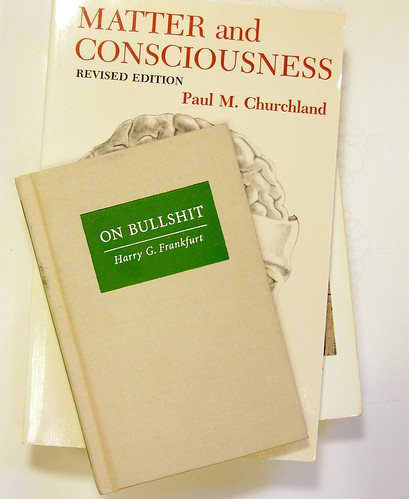
 We have been hammering away at eliminative materialism (EM) in a series of posts. If EM proponents fail to make their own position plausible or even coherent, how do they fare as critics of alternative views? Not much better. Let’s look at Paul Churchland’s treatment of dualism in (the 1988 revised edition of) his textbook Matter and Consciousness. (There’s the book’s cover at left. It’s better than the book itself, which I guess confirms the old adage. I considered using this illustration, but it seemed a bit impolite.)
There are two main problems with Churchland’s discussion. First, his summary of the case for dualism is no good. Second, his arguments against dualism are no good either. In this post we’ll look at the first problem and in a second post I’ll address the second.
What are the main arguments for dualism? Churchland identifies four; he calls them the argument from religion, the argument from introspection, the argument from irreducibility, and the argument from parapsychology. To anyone familiar with the philosophical literature on dualism, this list cannot fail to seem very odd.
One problem with it is that it includes two arguments – the “argument from religion” and the “argument from parapsychology” – that dualist philosophers actually put little or no emphasis on. As Churchland presents the “argument from religion,” it amounts to little more than the claim that “Dualism must be true, because my religion says it is.” He cites no philosophers as actually having given this argument, no doubt because there aren’t any. (Yes, a philosopher who happens to believe on independent grounds that his religion is true and that it entails dualism might present that as an argument for dualism to someone who already agrees with its premises. But no dualist philosopher I can think of has ever pretended that such an argument would be a good stand-alone argument for convincing either an irreligious materialist or even someone whose attitude toward either religion or dualism is noncommittal.)
The “argument from parapsychology” no doubt does have some defenders; certainly there are serious philosophers who have taken the subject of alleged paranormal phenomena seriously either in a sympathetic way (e.g. C. D. Broad and, in recent years, Stephen Braude) or in a critical spirit (e.g. Antony Flew). But this subject does not in fact play much of a role in contemporary debates over dualism, and even those philosophers who believe that at least some purported paranormal phenomena cannot plausibly be explained away in terms of existing scientific theory (e.g. Braude) do not necessarily put such claims forward, primarily or at all, as grounds for accepting dualism.
It is in any event a mistake to think that dualism is intended as a kind of scientific hypothesis put forward as the “best explanation” of the empirical evidence, parapsychological or otherwise. The central arguments for dualism have always been attempts at metaphysical demonstration, intended to show conclusively that whatever the mind is, it cannot even in principle be material. And this brings us to the most glaring fault with Churchland’s list: He simply ignores these key arguments entirely. For example, though he purports to summarize Descartes’ own reasons for endorsing dualism, and rightly notes that Descartes thought that certain key mental phenomena are irreducible to material phenomena, he fails even to mention the two arguments Descartes put the most emphasis on: the clear and distinct ideas argument (these days often called the conceivability argument or the modal argument), and the indivisibility argument (which is related to what is often called the unity of consciousness argument). The first argument (which I have discussed in a previous post) holds that since – the argument claims – it is metaphysically possible for mind to exist apart from anything material, it cannot be material. The second holds that the mind has a kind of unity or indivisibility-in-principle that nothing material can have. (Variations on this basic idea were also defended by the likes of Leibniz and Kant.)
It isn’t like these arguments are not well known. Nor are they mere historical relics; they have defenders to this day. (For those who are interested, I discuss them in detail in my book Philosophy of Mind.) The modal argument in particular received renewed attention in the wake of Kripke’s Naming and Necessity, and thus in the years leading up to the publication of Churchland’s book. It was defended by Richard Swinburne in The Evolution of the Soul, which appeared in 1986 – two years before Churchland’s revised edition – and by W. D. Hart in The Engines of the Soul, which itself came out in 1988. (Charles Taliaferro is another philosopher who has defended it in the years since, in his book Consciousness and the Mind of God.)
Churchland also ignores – as, in fairness, almost all contemporary philosophers of mind do – what early modern writers like Malebranche regarded as the central proof of dualism, viz. that dualism follows from the very mechanistic conception of matter Cartesians and materialists hold in common. For if color, odor, taste, sound, etc., as common sense understands them, do not exist in matter itself but only in our perceptual experience of matter, then those experiences cannot be material. (I have discussed this argument in previous posts as well, e.g. here and here.)
What is in fact the chief argument for dualism, at least from the point of view of the classical (Platonic-Aristotelian-Thomistic-Scholastic) traditions in philosophy, concerns, not sensory qualities or “qualia,” but rather our capacity for abstract thought. For concepts, and our thoughts about them, are universal in a way nothing material can be, and (sometimes, anyway) determinate, precise, or unambiguous in a way nothing material can be. (I have discussed this sort of argument too in many earlier posts, e.g. here and here.) While this line of argument has also been largely ignored by contemporary academic philosophers of mind, it was defended by Mortimer Adler in the years leading up to the publication of Churchland’s book, and by 20th century Thomist writers generally. Needless to say, Churchland ignores it as well.
So, while Churchland pretends to be summing up “some of the main considerations” usually given in support of dualism, he completely ignores the arguments the most prominent dualist philosophers actually regarded as the most important, and includes arguments that dualists do not typically make use of – arguments that are either clearly feeble (the “argument from religion,” as Churchland presents it) or which rest on premises which are as controversial as dualism itself is (the “argument from parapsychology”). The rhetorical effect is obvious: The unwary reader, who assumes that a textbook will give him an accurate summary of what each side has to say, is bound to come away with a completely distorted conception of the case for dualism. In particular, he is bound to think it far weaker than it actually is.
I am not claiming that Churchland is knowingly perpetrating what looks like a pretty sleazy rhetorical tactic. I think he is, like most materialists, simply ignorant of what most dualists have actually said. He no doubt thinks he knows enough about what they say to be justified in concluding that their position is not worth looking into any further than he already has. He is wrong, but will never know that he is, because he has gotten himself onto the sort of merry-go-round that (as we have seen in recent posts) naturalists seem to have so much difficulty keeping off of: “I know that dualism is too silly to investigate any further because of how bad the arguments for it are; and I know that I must be understanding those arguments correctly because dualism is obviously just too silly to be worth investigating any further.”
The thing is, books like Matter and Consciousness contribute to the formation of the same mindset in others. As generation after generation of philosophy students are taught out of such books, the conclusion that dualism is intellectually disreputable comes to seem something that “everyone knows.” In fact, what “everyone knows” is nothing more than a bunch of straw men and circular arguments, bounced around the materialist echo chamber long enough that no one can hear anything else. (This is, of course, exactly parallel to what most atheist philosophers “know” about the classical arguments for God’s existence, as I have noted here, here, and here. The hegemony of atheism and materialism crucially depend on a stubborn and studied ignorance of what theists and dualists have actually said.)
Having said all that, Churchland is at least correct to say that what he calls the "argument from introspection" and the "argument from irreducibility" are prominent arguments for dualism. Unfortunately, what he says about these arguments is no good either. We’ll see why in part II.